Our Training Programs

Learn from industry practitioners

Hands-on, enterprise-grade training in Oracle PL/SQL, Data Science & AI, and Oracle Database Administration. Click any course to view the full outline.
Oracle PL/SQL Training

Procedural Language for SQL · 8 modules
View outline

Module 1 — Programming Fundamentals & PL/SQL Introduction

  • Overview of Programming Languages
  • Introduction to Oracle PL/SQL & its architecture
  • Key benefits, features and PL/SQL data types
  • Variables, constants and built-in functions
  • Conditional & unconditional statements: IF, IF-ELSE, Nested IF-ELSE, IF-ELSE ladder
  • CASE statements, GOTO, labels and EXIT statements

Module 2 — Iterative Processing & SQL Integration

  • Looping techniques: Simple LOOP, WHILE, FOR and nested loops
  • Executing SQL statements within PL/SQL blocks
  • Composite data types and collections

Module 3 — Cursor Management

  • Implicit & explicit cursors and cursor attributes
  • Parameterized cursors, cursors with loops and nested cursors
  • Cursors with subqueries and REF cursors
  • Records and PL/SQL table types

Module 4 — Advanced PL/SQL Programming

  • Creating and managing stored procedures
  • IN, OUT and IN OUT parameters
  • Positional and named notation; procedures using cursors
  • Modifying and dropping procedures

Module 5 — Functions in PL/SQL

  • User-defined functions and nested functions
  • Differences between procedures and functions
  • Using stored functions in SQL statements

Module 6 — Packages

  • Package specifications and bodies
  • Public and private package objects
  • Best practices for package development

Module 7 — Exception Handling

  • Predefined and user-defined exceptions
  • RAISE_APPLICATION_ERROR and PRAGMA AUTONOMOUS_TRANSACTION
  • Understanding SQL error codes and messages

Module 8 — Database Triggers

  • Types of triggers; row-level and statement-level triggers
  • DDL triggers and trigger-based auditing techniques

Course Outcome

  • By the end of this training, participants will be able to design, develop, debug and optimize PL/SQL programs, manage database objects efficiently, and build enterprise-grade database applications.

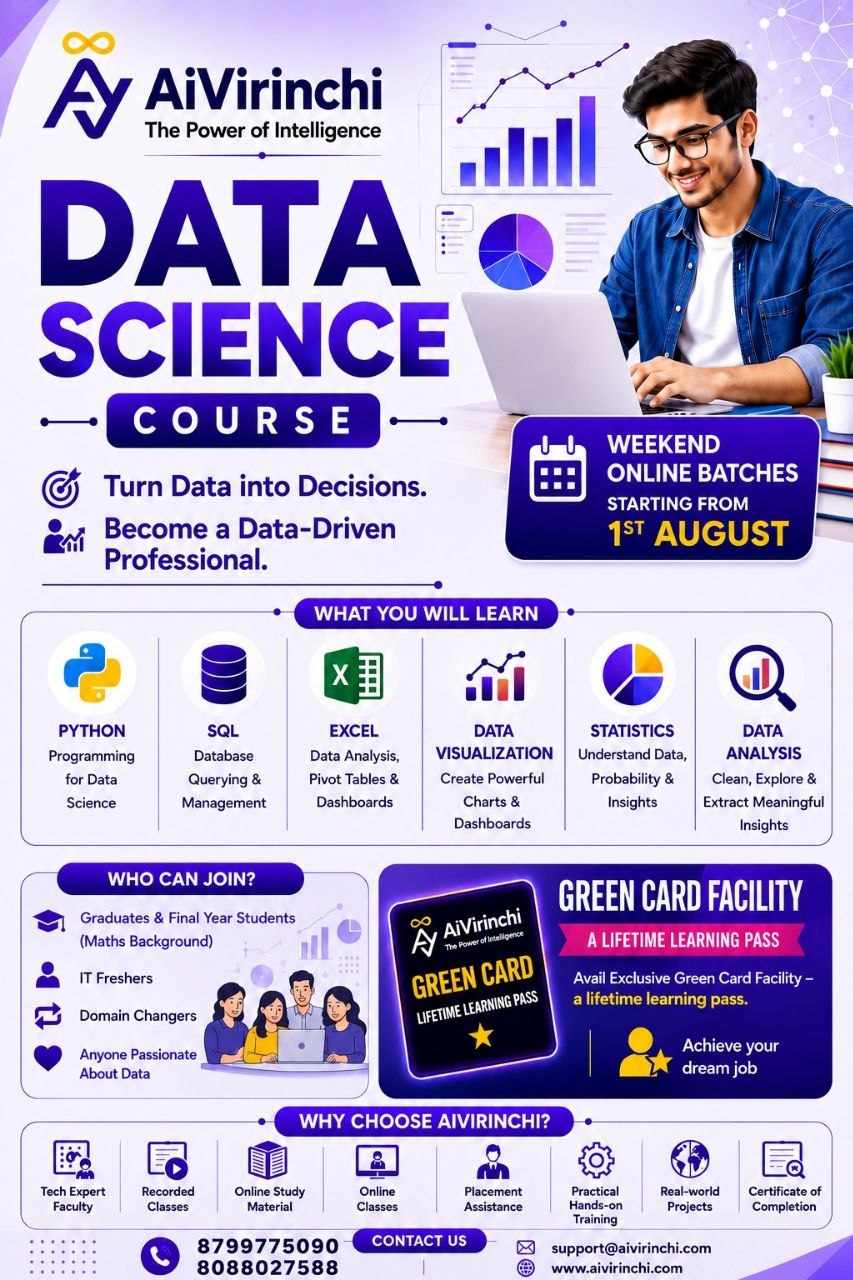
Data Science & AI Certification

Advanced Certification in Data Science and AI · 15 modules
View outline

Module 1 — Preparatory Sessions: Python & Linux

  • Python: introduction to IDEs, basics, OOP and hands-on practice
  • Linux: introduction, basics and hands-on assignments

Module 2 — Data Wrangling with SQL

  • SQL basics & advanced SQL
  • User-defined functions
  • SQL optimization and performance

Module 3 — Python with Data Science

  • Data handling with NumPy
  • Data manipulation using Pandas
  • Data preprocessing and visualization

Module 4 — Linear Algebra & Advanced Statistics

  • Descriptive statistics and probability
  • Inferential statistics
  • Linear algebra

Module 5 — Machine Learning

  • Introduction to Machine Learning
  • Regression, classification and clustering

Module 6 — Supervised Learning

  • Linear & logistic regression, decision tree, random forest
  • SVM, K-Nearest Neighbors, time series forecasting
  • Performance metrics, classification reports, confusion & evaluation matrix

Module 7 — Unsupervised Learning

  • K-means and dimensionality reduction
  • Linear Discriminant Analysis & Principal Component Analysis

Module 8 — Deep Learning Using TensorFlow

  • Artificial Intelligence and neural network basics
  • Deep learning

Module 9 — Data Science Capstone Project

  • ETL and data pre-processing to gather insights
  • Feature engineering and scaling
  • Model selection, building and evaluation across supervised/unsupervised algorithms

Module 10 — Business Case Studies

  • Recommendation engine, rating predictions, census, housing
  • Object detection, stock market analysis, banking problem, AI chatbot

Module 11 — Generative AI

  • LSTM, Transformers, BERT, GPT and LLMs

Module 12 — Elective: Power BI

  • Power BI basics, DAX and data visualization with analytics

Module 13 — Deploying ML Models with Cloud

  • Introduction to MLOps and deploying machine learning models

Module 14 — GIT

  • Version control and Git

Module 15 — Data Analysis with MS-Excel

  • Excel fundamentals and Excel for data analytics
  • Data visualization, Excel power tools and classification problems
  • Information measure, regression problems and hands-on exercises

Oracle Database Administration

Comprehensive curriculum · 27 topics incl. ASM & advanced RMAN
View outline

1–5 — Architecture, Installation & Instance Management

  • Oracle Database and ASM architecture; process and memory structures
  • Installing Oracle software with OUI and Grid Infrastructure (incl. silent installs)
  • Creating databases with DBCA; templates and security
  • Managing the Oracle instance; startup/shutdown stages, alert logs, ASM
  • Configuring the Oracle network environment and the Listener

6–11 — Storage, Security & Performance

  • Managing storage structures, tablespaces and Oracle Managed Files (OMF)
  • Administering user security, roles and profiles
  • Managing data concurrency, locks and deadlocks
  • Managing undo data and retention
  • Database auditing and audit trail maintenance
  • Performance management: AWR, ADDM, AMM and tuning views

12–16 — Backup, Recovery & Data Movement

  • Backup & recovery concepts; instance recovery and MTTR Advisor
  • Performing backups with RMAN and the Flash Recovery Area
  • Database recovery and the Data Recovery Advisor
  • Data movement: SQL*Loader, external tables and Oracle Data Pump
  • Working with Oracle Support and managing patches

17–23 — Advanced RMAN

  • RMAN recovery catalog, stored scripts and virtual private catalog
  • Configuring backup specifications, channels and optimization
  • Image copies, incremental, compressed and encrypted backups
  • User-managed backup and recovery scenarios
  • RMAN recovery operations, restoring to a new host
  • RMAN database duplication and cloning
  • Monitoring and tuning RMAN performance

24–27 — ASM & Advanced Topics

  • Automatic Storage Management fundamentals and disk groups
  • Failure groups, redundancy and disk group management
  • Creating and managing databases on ASM
  • Advanced RMAN: strategies, troubleshooting and best practices

Want to enroll or schedule a batch?

Reach out and we'll share the schedule, format and pricing for your team.

Enquire About Training